



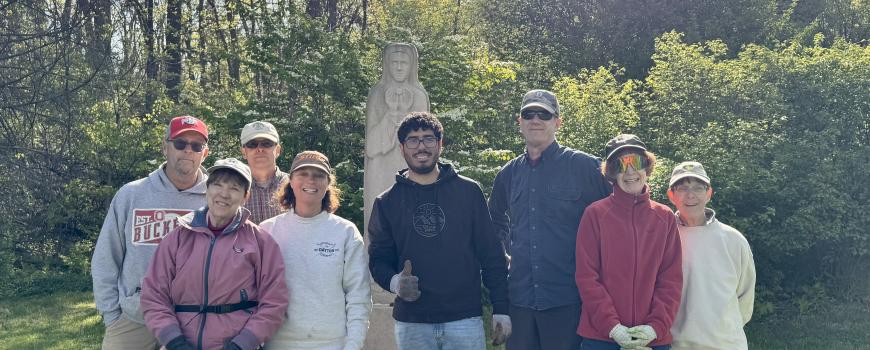
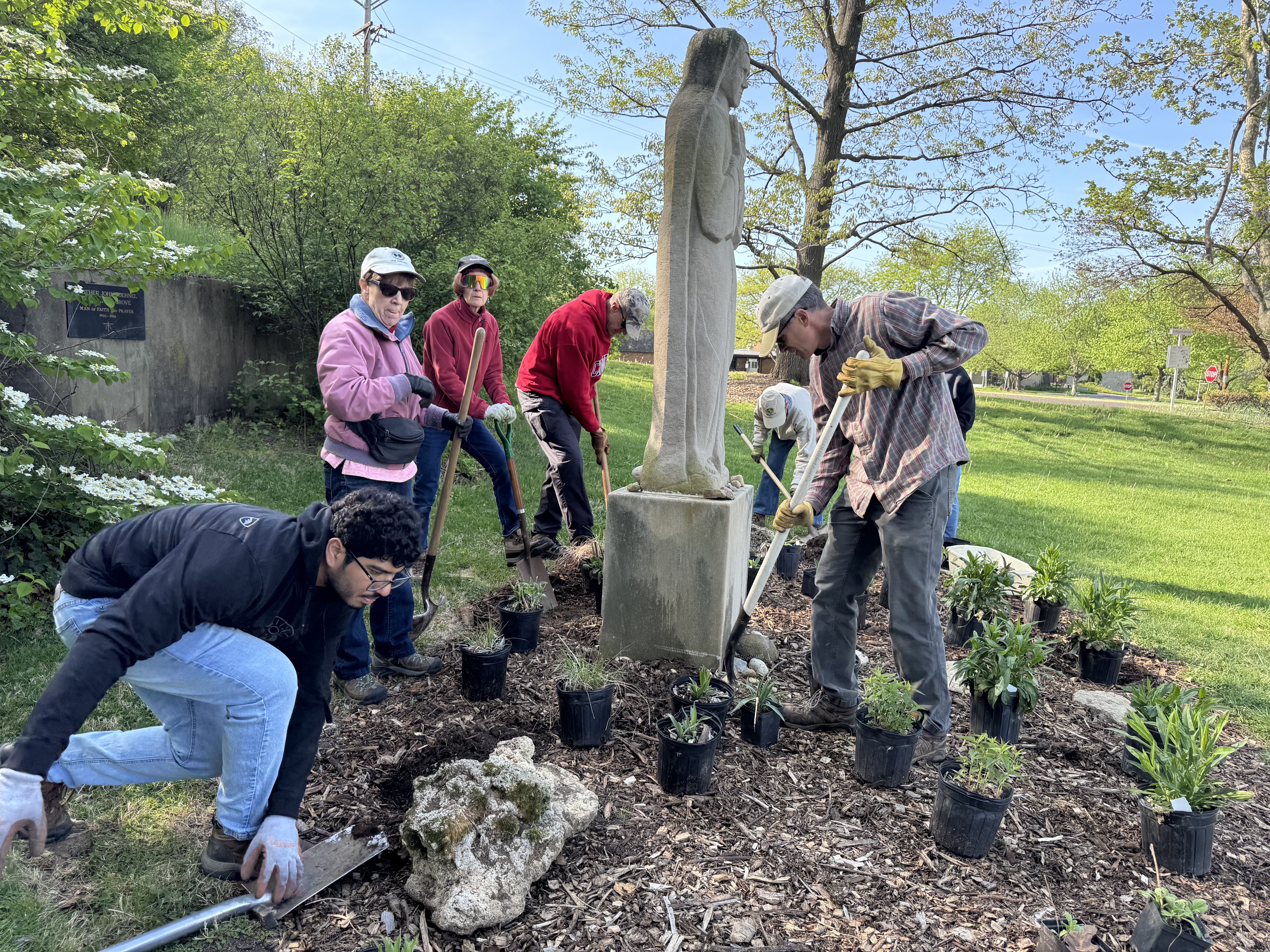
On Tuesday, April 21, in honor of Earth Week and the first anniversary of the death of Pope Francis, MEEC volunteers joined staff to break ground and plant a new Mary Garden with native plants around the statue of Our Lady of the Eucharist in front of the Bro. John Soehnel, SM Meditation Grove at Mount Saint John.
The practice of gathering plants that reminded the faithful of Mary around her statues originated in the medieval period, especially in European monasteries and convents. Garden plants had become inculturated with Marian names for many reasons: bloom times that coincided with one of her feasts, physical attributes that called to mind one of her characteristics, or resemblance to an artifact from her life. The US Mary Garden movement blossomed in the 1950s as Catholics planted the same European plants around their homes as Marian devotions. The person mostly responsible for this revival, John Stokes, also saw Mary gardens "as a recovery of an entire worldview that approached nature as a witness to its Creator and Redeemer, inspiring the praise of God and virtuous living."1
Pope Francis' 2015 encyclical Laudato Si' made clear just how critical a worldview of reverence is for our Church and our world, and the science of ecology has taught us the importance of using native plants in our home landscapes. Based on the early work of Vincenzina Krymow, MEEC is identifying native species that are taxonomically, phenologically, or visually similar to traditional Mary plants, as well as cultivating associations between our most ecologically important plants and contemporary, scripture-based characteristics of Mary.
One example of a "new" Mary plant is little bluestem, Schizachyrium scoparium. Among the six original grass species Bro. Don Geiger, SM planted when he established one of the first recreated prairies in Ohio in a sand and gravel borrow pit here at Mount Saint John, "little blue" colonized the most barren area at the bottom of the pit. For 40 years its roots have slowly and faithfully worked to liberate minerals from the till and convert them into biomass which every year decays, adding precious humus to the matrix and creating life-giving soil. It is birthing the conditions for life to thrive.
Little Bluestem is one of seven species we planted this morning. The others are Ashy sunflower (Helianthus mollis), rattlesnake master (Eryngium yuccifolium), wild bergamot (Monarda fistulosa), foxglove beardtongue (Penstemon digitalis), gray goldenrod (Solidago nemoralis), and hoary vervain (Verbena stricta).
For the 2026 Marian Forum hosted by the International Marian Research Institute at the University of Dayton, MEEC Director Sr. Leanne Jablonski, FMI composed the following Little Bluestem Prayer. We invite you to join your prayers with ours in the hope that our collective efforts toward justice, peace and reconciliation be transformed by the One who reconciles all into the kin-dom.
Little Bluestem Prayer
Creator God, thank you for little bluestem grass,
Whose deep roots transform the hardest rock into
life-sustaining soil.
Teach us to be rooted in you as we care for your Creation.
Soften our hearts with your compassion.
Help us to see the broken and disadvantaged
With your love, as we work for peace and reconciliation.
Mary, walk with us and teach us the patience of the
prairie, the beauty of simplicity, and faithfulness
in times of challenge.
Grow our little efforts into great welcoming communities
that ever glorify God.
1 Groppe, Elizabeth T. "To win back for Our Lady the flowers of the field: Ecology, Stewardship, and Prayer in the Mary's Gardens Apostolate." U.S. Catholic Historian, vol. 43 no. 2, 2025, p. 51-76.